Learn how to excel at leadership and management
Sign up for our newsletter and get access to a broad range of training information and materials which will help to improve your business processes and career prospects.

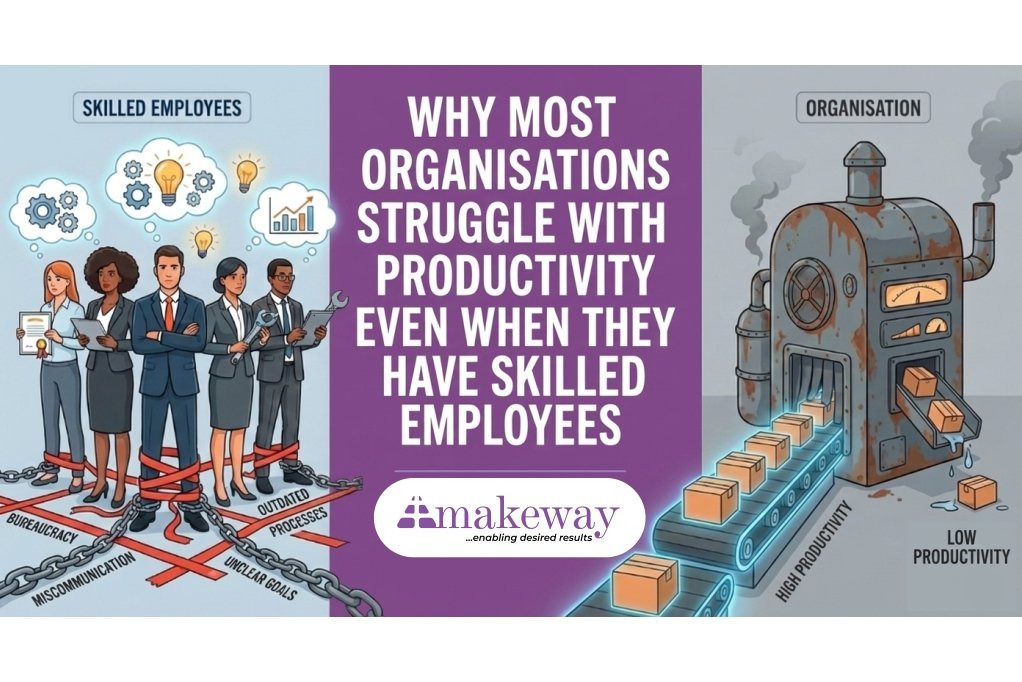
In today’s competitive business environment, many organisations proudly boast a workforce filled with highly skilled employees, impressive qualifications, and years of experience. Yet, despite this apparent strength, productivity levels remain disappointingly low. This paradox leaves leaders asking a critical question: why do organisations struggle with productivity even when talent is not the problem?
The truth is that skills alone do not guarantee productivity. Productivity is a complex outcome shaped by systems, culture, leadership, and strategy. When these elements are misaligned, even the most capable employees underperform.
One of the biggest reasons organisations struggle with workplace productivity is the absence of clear goals and expectations. Skilled employees need more than tasks; they need purpose.
When organisational goals are vague or constantly changing:
• Employees work hard but not smart
• Effort is duplicated or wasted
• Teams pull in different directions
Without a clear link between daily tasks and business objectives, productivity becomes fragmented rather than focused.
Leadership plays a decisive role in unlocking or suppressing productivity. Many organisations promote technically skilled individuals into management roles without equipping them with leadership and people management skills.
Common leadership-related productivity blockers include:
• Micromanagement
• Poor communication
• Lack of feedback and recognition
• Failure to empower employees
Even highly skilled employees disengage when leadership fails to inspire trust and autonomy.
Skilled employees are often forced to operate within inefficient workflows, outdated technology, and bureaucratic procedures. This leads to frustration, delays, and wasted effort.
Productivity suffers when:
• Employees spend more time navigating systems than doing meaningful work
• Manual processes replace automation
• Decision-making is slowed by excessive approvals
No amount of skill can compensate for broken systems.
A toxic or unsupportive organisational culture can silently destroy productivity. Skilled employees thrive in environments that encourage collaboration, trust, and psychological safety.
Low productivity cultures are often characterised by:
• Fear of making mistakes
• Office politics
• Lack of recognition
• Resistance to innovation
When employees feel undervalued or unsafe to express ideas, they do the bare minimum instead of their best work.
Many organisations confuse long working hours with productivity. In reality, burnout reduces efficiency, creativity, and decision-making quality.
Even skilled employees struggle when:
• Workloads are unrealistic
• There is no work–life balance
• Mental health is ignored
Sustainable productivity requires energy, focus, and wellbeing — not constant pressure.
Skilled employees cannot perform optimally in silos. When communication breaks down across departments, productivity suffers due to misunderstandings, delays, and rework.
Symptoms of poor collaboration include:
• Conflicting priorities
• Information hoarding
• Lack of cross-functional teamwork
Effective communication aligns talent with organisational goals.
What gets measured gets managed. Many organisations fail to track meaningful performance metrics, focusing instead on activity rather than outcomes.
Without regular feedback:
• Employees don’t know if they are performing well
• Skills are underutilised
• Improvement opportunities are missed
Productivity improves when employees understand how their performance is measured and how they can improve.
Having skilled employees does not automatically mean they are placed in the right roles. Misalignment between skills and responsibilities leads to underperformance.
This happens when:
• Employees are overqualified or underutilised
• Roles are poorly designed
• Strengths are ignored in favour of rigid job descriptions
Strategic talent deployment is essential for productivity.
Most organisations do not struggle with productivity because their employees lack skills. They struggle because systems, leadership, culture, and strategy fail to support those skills.
To unlock true productivity, organisations must:
• Provide clear direction
• Invest in effective leadership
• Streamline processes
• Foster a positive workplace culture
• Prioritise wellbeing
• Measure what truly matters
When skilled employees are supported by the right environment, productivity becomes a natural outcome rather than a constant struggle.
_____________________________________________________________________
Please click HERE to share your interest in our course
For enquiries: send us a message via our email address – training@makewayglobal.com
Also follow us on – LinkedIn |Instagram | X | Facebook