
Learn how to excel at leadership and management
Sign up for our newsletter and get access to a broad range of training information and materials which will help to improve your business processes and career prospects.

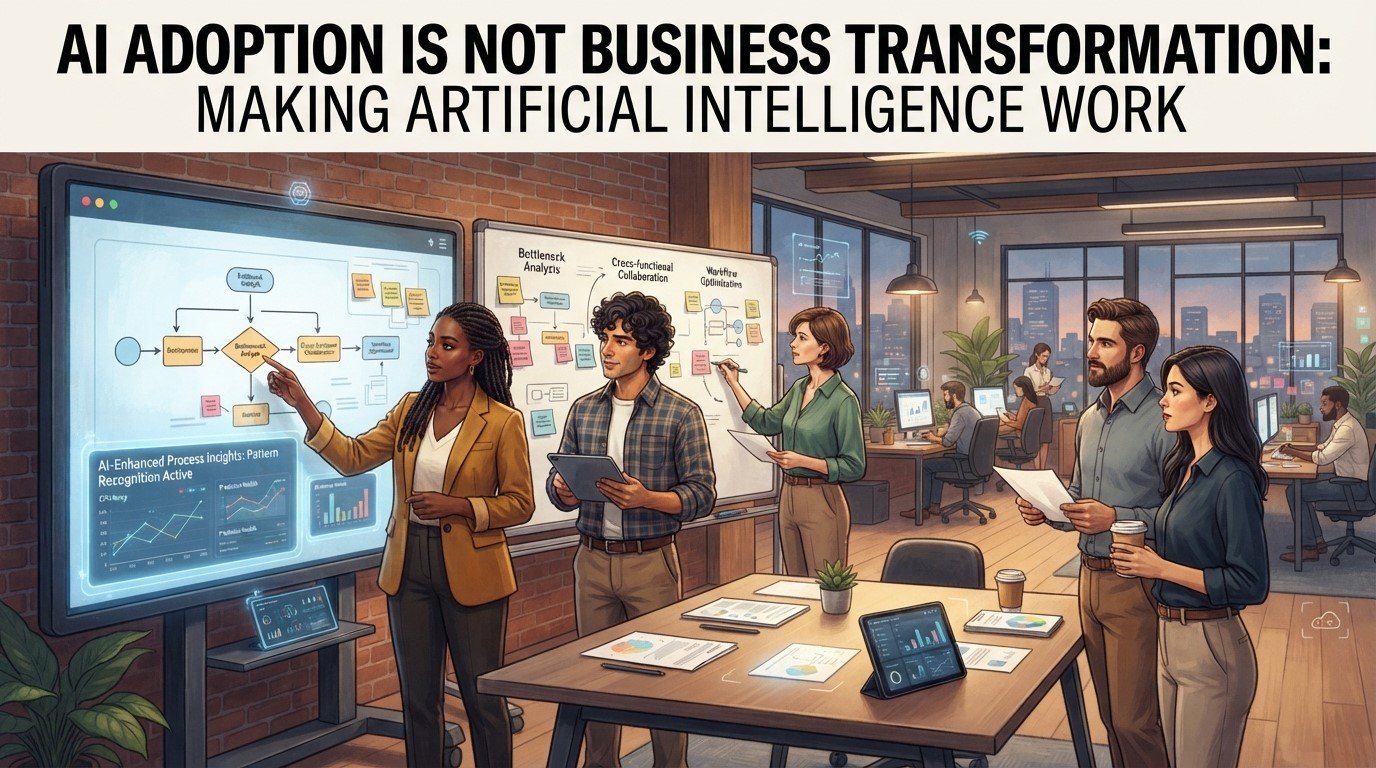
AI ADOPTION IS NOT BUSINESS TRANSFORMATION: MAKING ARTIFICIAL INTELLIGENCE WORK
Artificial intelligence (AI) has moved rapidly from a specialist technology discussion into everyday organisational life. Employees use AI to draft communications, summarise information, analyse data, generate ideas and support decisions. Organisations are exploring applications in customer service, finance, human resources, operations, marketing and strategy.
However, adopting artificial intelligence is not the same as transforming a business.
The distinction matters because an organisation can use more technology without fundamentally improving how it works. It can automate isolated tasks while leaving inefficient processes untouched, generate more information without improving decisions, or increase individual productivity without creating better outcomes for customers.
The real question is not how much AI an organisation is using. It is whether the organisation is becoming more effective because of it.
START WITH THE BUSINESS, NOT THE TECHNOLOGY
A common mistake is to begin with a tool and then search for places to use it. A new AI application becomes available, and departments are encouraged to experiment. People find tasks it can perform, often with useful results.
Experimentation has value, but technology should not determine the organisation’s priorities.
A better starting point is to examine the business: What are the organisation’s strategic priorities? Where are customers experiencing delays or frustration? Which processes consume unnecessary time or resources? Where are errors, duplication or rework occurring? Which decisions would benefit from better information?
For example, a bank may introduce a chatbot to answer routine customer questions. That may reduce pressure on its contact centre. However, if customers still need to repeat information when their enquiry is transferred, or if the underlying process for resolving complaints remains slow, the wider customer experience may not improve significantly.
The opportunity is to examine the complete customer journey and determine where AI can remove friction, improve responsiveness and support better resolution. Basically, the business objective should lead; the technology should serve it.
REDESIGN THE WORK, NOT JUST THE TASK
Many AI applications are introduced as an additional layer on top of existing work. Employees use AI to prepare a report more quickly, draft a response or summarise a meeting, but the process around that task remains unchanged.
This can produce local efficiency without meaningful organisational improvement.
Consider a process that requires information to pass through several departments before a decision is made. AI may help each department prepare its contribution faster. Yet if the process still contains unnecessary approvals, unclear responsibilities and repeated handovers, the overall delay may remain.
Transformation requires a wider examination of how work is organised from beginning to end. Which steps are necessary? Which can be removed or combined? Where should decisions be made? What information is needed, and who needs it? Which activities are suitable for AI, and where is human judgement essential?
This is consistent with the principle that strategy must reach the work. Strategic ambition becomes meaningful when it changes the way work is actually performed.
INVOLVE EMPLOYEES IN MAKING AI WORK
AI transformation cannot be delivered solely by a technology department or a small group of senior executives. Employees understand the practical realities of their work. They know where information is difficult to obtain, where procedures create unnecessary effort and where exceptions regularly occur. Their experience is essential when identifying suitable applications and redesigning processes.
Organisations need to explain why AI is being introduced, what it is expected to improve, what will remain a human responsibility and how employees will be supported. Training should go beyond showing people which buttons to press. It should develop the judgement to frame problems, assess outputs, recognise limitations and use the technology responsibly.
The objective should be to strengthen people’s contribution, not simply increase the number of AI tools they are expected to use.
ESTABLISH ACCOUNTABILITY AND APPROPRIATE SAFEGUARDS
AI can produce inaccurate, incomplete or misleading outputs. It may reflect weaknesses in the data on which it relies, expose confidential information if used carelessly or generate recommendations that are unsuitable for a particular decision.
These are business management issues, not merely technical matters. Organisations need clear rules about which tools may be used, what information may be entered, how outputs should be checked and which decisions require human approval. Accountability must be clear when AI contributes to an error or an adverse outcome.
The National Institute of Standards and Technology’s AI Risk Management Framework provides guidance for organisations seeking to incorporate trustworthiness and risk management into the design, use and evaluation of AI systems.
Responsible adoption requires proportionate controls, clear ownership and continuing review. Trust is not created by assuming that a system is reliable; it is built by understanding where it can fail and managing those risks.
MEASURE BUSINESS OUTCOMES, NOT AI ACTIVITY
It is easy to report the number of employees trained, licences purchased, tools deployed or pilot projects completed. These figures describe activity, but they do not demonstrate business transformation.
The more important measures relate to the organisation’s objectives. Has customer waiting time reduced? Are decisions more accurate? Has rework fallen? Are employees spending less time on repetitive administration and more time on work that requires expertise? Has service quality improved? Has the organisation created new revenue or improved its ability to respond to the market?
Recent enterprise research reinforces this distinction. Deloitte’s 2026 enterprise AI report found that while organisations are seeing productivity benefits, only 34% reported using AI to deeply transform their businesses through new products, services, core processes or business models. McKinsey’s 2026 State of AI report also found a gap between individual productivity improvements and wider financial impact: although eight in ten respondents said AI had improved their own productivity, the proportion reporting an AI contribution to organisational EBIT remained at 37%.
These findings underline an important point: gains at individual task level do not automatically translate into stronger organisational performance.
This is why performance management should improve performance. Measures should help management understand whether the intended results are being achieved and what further changes are necessary.
MAKE IMPROVEMENT CONTINUOUS
AI transformation is not a one-off technology project. Tools will evolve, business needs will change and employees will discover new opportunities as they gain experience.
Organisations therefore need a disciplined way to review results, learn from implementation and make adjustments. A pilot that does not deliver the expected benefit should not be scaled simply because time and money have already been invested. Equally, a successful application should be examined for lessons that may be useful elsewhere.
As with any other improvement initiative, continuous improvement is not just a business strategy. It must become part of how the organisation thinks, manages and works.
THE TRANSFORMATION IS IN THE RESULTS
Artificial intelligence offers significant possibilities, but its presence in an organisation is not proof of progress.
Leaders must resist the temptation to equate visible AI activity with transformation. The more demanding task is to rethink how work gets done, how decisions are made and how value is created for customers and other stakeholders.
The test is straightforward: what is the organisation now able to do better because of AI?
If the answer is limited to producing the same outputs a little faster, the organisation may have adopted a useful tool. If it can deliver better service, make stronger decisions, remove unnecessary work, create new value and improve performance sustainably, it may be achieving genuine business transformation.
AI should not become another initiative that sits alongside the real work of the organisation. It should help improve that work. That is how artificial intelligence begins to make a meaningful difference.
—
ABOUT KOLA OLUTIMEHIN
Kola Olutimehin (getKOLA) is a Business Excellence Consultant who assists organisations in achieving operational excellence through effective management, employee engagement, continuous improvement and organisational transformation.
He is a Director with the International Lean Six Sigma Institute (ILSSI), the David Hutchins International Quality College (DHIQC) and the Global Excellence Team (GET).
The International Lean Six Sigma Institute (ILSSI) is one of the leading international Lean Six Sigma professional and certification organisations, recognised globally. Kola’s involvement with ILSSI, DHIQC and GET reflects his continuing work in business excellence, operational excellence, quality and continuous improvement.
If you find these reflections useful, follow Kola Olutimehin (getKOLA) for more insights on business excellence, management and organisational transformation. You may also subscribe to our newsletters here or connect with Kola through getKOLA.


—
Written by Kola Olutimehin
© 2026 Kola Olutimehin. All rights reserved.
No part of this article may be reproduced or redistributed without prior written permission from Kola Olutimehin, except where permitted by law.
_____________________________________________________________________
For enquiries: send us a message HERE or via email at training@makewayglobal.com
Follow us on – LinkedIn | Instagram | X | Facebook
📩 Email: training@makewayglobal.com 🌐 Website: www.makewayglobal.com