
Learn how to excel at leadership and management
Sign up for our newsletter and get access to a broad range of training information and materials which will help to improve your business processes and career prospects.

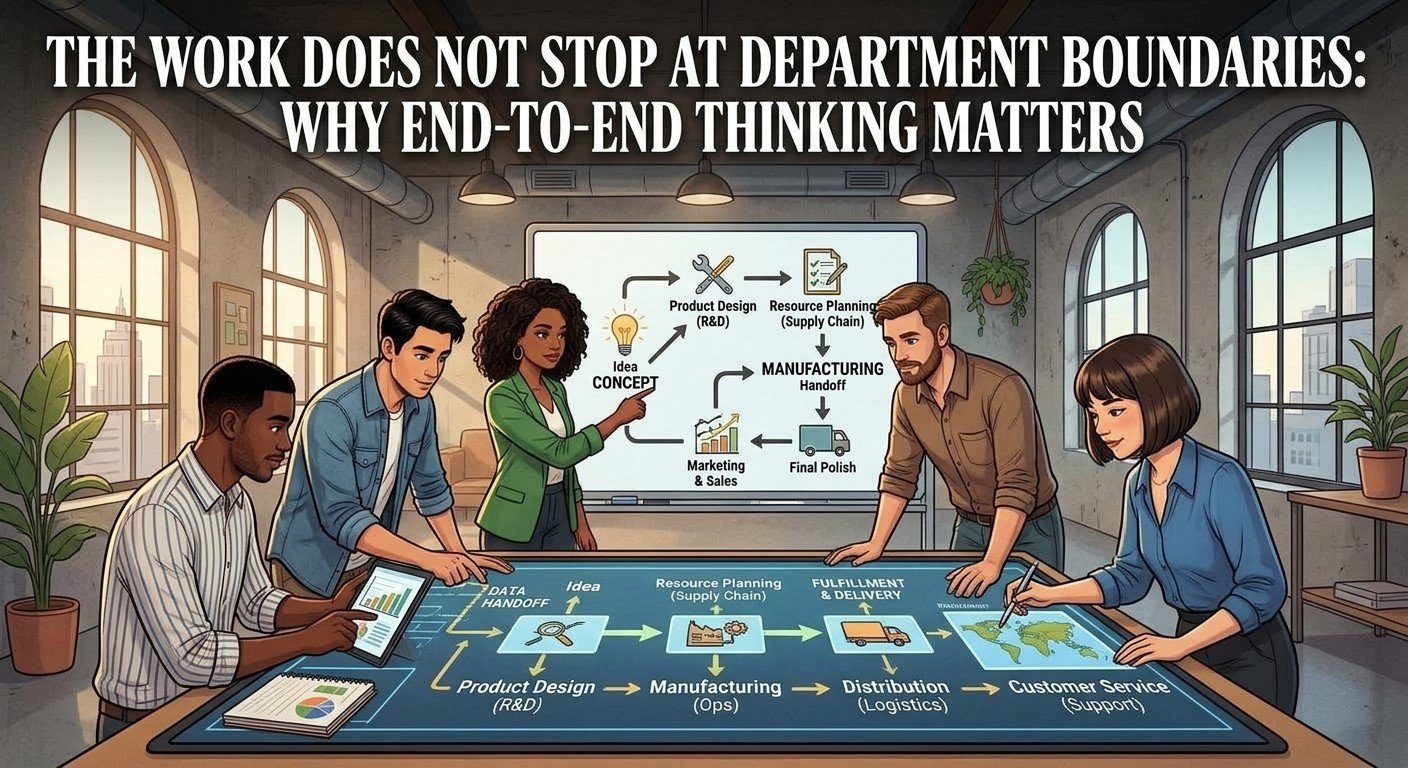
THE WORK DOES NOT STOP AT DEPARTMENT BOUNDARIES: WHY END-TO-END THINKING MATTERS
Organisations divide work into departments so that people can develop specialist knowledge and manage particular responsibilities. This structure creates focus and helps coordinate expertise.
However, customers do not experience an organisation as separate departments. They experience a process that may pass through several teams before a product is delivered, a service is completed or a request is resolved. When each department concentrates only on its own tasks, the overall result can suffer.
A department may meet its targets while work waits elsewhere or customers experience avoidable delays. The organisation can therefore be locally efficient and collectively ineffective.
End-to-end thinking helps address this gap. It shifts attention from whether each function has completed its own tasks to whether the entire process delivers the intended result.
THE CUSTOMER EXPERIENCES THE WHOLE PROCESS
Consider a customer request requiring information from one team, approval from another and final action by a third. Each department may complete its part within its own time limit, yet the customer waits because the request sits between stages or is returned for missing information.
From the perspective of each department, its own work may be complete. From the customer’s perspective, the service is not complete until the promised outcome has been delivered.
Organisational performance should therefore consider not only departmental output, but also the time, quality and reliability of the complete process.
That wider view is central to operational excellence. Efficiency within one department is useful, but it does not guarantee that the organisation is delivering value effectively. The handovers, waiting periods and connections between activities deserve as much attention as the activities themselves.
DEPARTMENTAL TARGETS CAN PULL IN DIFFERENT DIRECTIONS
Local targets clarify expectations and help managers monitor performance. They become problematic when departments optimise their own results without considering the wider process.
A sales team may be rewarded for securing new business, for example, and therefore promise delivery dates that operations cannot consistently meet. Operations may focus on maximising output, even when the items being produced are not the ones customers need most urgently. Finance may strengthen controls to reduce risk, but if the approval process is unnecessarily slow, the wider service may suffer.
None of these functions is necessarily acting irresponsibly; each may be responding to the measures and expectations it has been given. The problem is that those expectations are not sufficiently connected to the overall outcome.
This is why performance measures should be examined for their wider effects. A target that improves one department’s results while increasing delays, rework or cost elsewhere may be encouraging the wrong behaviour. The important question is not simply whether a team achieved its target, but whether its performance helped the complete process succeed.
FOLLOW THE WORK FROM BEGINNING TO END
The first step towards end-to-end thinking is to understand how the work actually flows. Identify where the process begins, what needs to happen at each stage, who receives the work next and what constitutes a completed outcome.
Do not rely only on procedure documents. Observe what happens in practice and speak with the people who carry out and receive the work. Look for waiting, repeated checks, unclear information, avoidable approvals and work that returns to an earlier stage.
A process may look straightforward on a diagram but operate differently in reality. An approval may sit in an inbox for days; a team may receive incomplete requests; or a system may record a task as completed while the customer still needs to make contact to resolve the issue.
Following the work in this way helps reveal the difference between completing individual activities and delivering the intended outcome. It also discourages the assumption that the department where a delay becomes visible must be the source of the problem.
EXAMINE THE HANDOVERS, NOT JUST THE DEPARTMENTS
Many process difficulties occur where work passes from one person or team to another. A handover may depend on information that has not been provided, a decision that is not clearly assigned or a receiving team that does not know when the work is ready.
These weaknesses create queues, repeated enquiries and rework. Departments may also protect themselves by recording that work has been passed on, even when the receiving team cannot act on it.
A useful handover clarifies what is being transferred, what information accompanies it, who must act and what happens when something is missing. The receiving person should not have to reconstruct the request’s history.
This is not an argument for adding forms and approvals to every exchange. The aim is to make the necessary information and responsibility clear, while removing steps that do not help the process move towards its intended result.
GIVE THE COMPLETE PROCESS A CLEAR OWNER
When responsibility is divided among departments, the overall process may have no clear owner. Each manager is accountable for a function, but nobody looks after performance across the boundaries.
An end-to-end process needs someone responsible for understanding its performance, coordinating improvements and bringing unresolved issues to decision-makers. This does not mean taking over every operational decision; it means keeping the overall outcome in view and ensuring that cross-department problems are addressed.
The owner must work with relevant functions, understand their constraints and help resolve conflicts between local priorities. Without cooperation and appropriate authority, process ownership risks becoming a title without influence.
MEASURE THE RESULT THAT THE PROCESS IS MEANT TO DELIVER
End-to-end thinking should influence what the organisation measures. Departmental indicators may still be necessary, but they should be balanced with measures that reveal the performance of the complete process.
Depending on the type of work, these could include the time from the initial request to final delivery, the proportion of cases completed correctly the first time, the number of times work is returned between stages, the frequency of missed commitments or the quality of the result experienced by the customer.
These measures expose problems hidden by departmental reporting and provide a common basis for improvement.
As discussed in Performance Management Should Improve Performance, Not Just Measure It, measures are most useful when they help people understand performance and decide what needs to improve. A collection of departmental figures is not enough if nobody can see how they combine to produce the result that matters.
ALIGN PEOPLE AROUND THE SHARED OUTCOME
Departments cannot deliver end-to-end performance if conflicting expectations remain. People need to understand the shared outcome, how their work contributes and where their decisions affect other stages.
This requires communication across functions, not endless meetings. A focused review of delays, handover problems and customer outcomes can help the right people agree what needs to change and follow through.
Senior leaders have an important role in resolving conflicts that teams cannot settle themselves. They need to ensure that local targets, resources and priorities support the wider direction rather than compete with it.
This reflects the principle in Strategy Must Reach the Work: Why Organisational Alignment Matters. Organisational priorities become meaningful when they influence the way work is coordinated across functions and when the experience of delivering that work can inform decisions.
IMPROVE THE FLOW, NOT JUST THE INDIVIDUAL TASKS
Once the process is understood, improvement should focus on how its stages connect. A department may complete its task faster but create a larger queue for the next team, making the overall result worse.
Sometimes the best improvement is to remove an unnecessary handover. In other cases, it may involve providing information earlier, clarifying a decision, changing the sequence of activities or giving people the authority to resolve a straightforward issue without passing it through several levels.
Consider each change across the complete process. Involve the people doing the work, test it where appropriate and check that it improves the outcome without creating problems elsewhere. Once established, communicate the new method to the relevant teams.
The aim is not to eliminate every departmental boundary. Specialisation remains valuable. The aim is to ensure that those boundaries do not become barriers to delivering a complete and reliable outcome.
A QUESTION FOR REFLECTION
Think of a process in your organisation that involves two or more departments. If each department completed its own responsibilities successfully, would the customer or final recipient necessarily receive the expected result on time and without avoidable difficulty?
If the answer is uncertain, follow the work from beginning to end. Examine handovers, waiting periods, information exchanged and performance measures.
An organisation does not create value simply because every department is busy or every function achieves its individual targets. It creates value when the different parts work together to deliver the outcome they exist to provide.
The work may pass through many departments, but the result belongs to the organisation as a whole.
—
ABOUT KOLA OLUTIMEHIN
Kola Olutimehin (getKOLA) is a Business Excellence Consultant who helps organisations achieve operational excellence through effective leadership, employee engagement, continuous improvement and organisational transformation.
If you find these reflections useful, follow Kola Olutimehin (getKOLA) for more thoughts on leadership, business excellence, organisational transformation, achievement and purposeful growth. You may also subscribe to our newsletters here, and connect with Kola via getKOLA.


Kola Olutimehin is a Business Excellence Consultant, who assists organisations in the achievement of operational excellence. He is a Director with the International Lean Six Sigma Institute (ILSSI), the David Hutchins International Quality College (DHIQC), and the Global Excellence Team (GET).
The International Lean Six Sigma Institute (ILSSI) is one of the leading international Lean Six Sigma professional and certification organisations, recognised globally. Kola’s involvement with ILSSI, DHIQC and GET reflects his continuing work in business excellence, operational excellence, quality and continuous improvement.
—
Written by Kola Olutimehin
© 2026 Kola Olutimehin. All rights reserved.
No part of this article may be reproduced or redistributed without prior written permission from Kola Olutimehin, except where permitted by law.
_____________________________________________________________________
For enquiries: send us a message HERE or via email at training@makewayglobal.com
Follow us on – LinkedIn | Instagram | X | Facebook
📩 Email: training@makewayglobal.com 🌐 Website: www.makewayglobal.com