Learn how to excel at leadership and management
Sign up for our newsletter and get access to a broad range of training information and materials which will help to improve your business processes and career prospects.

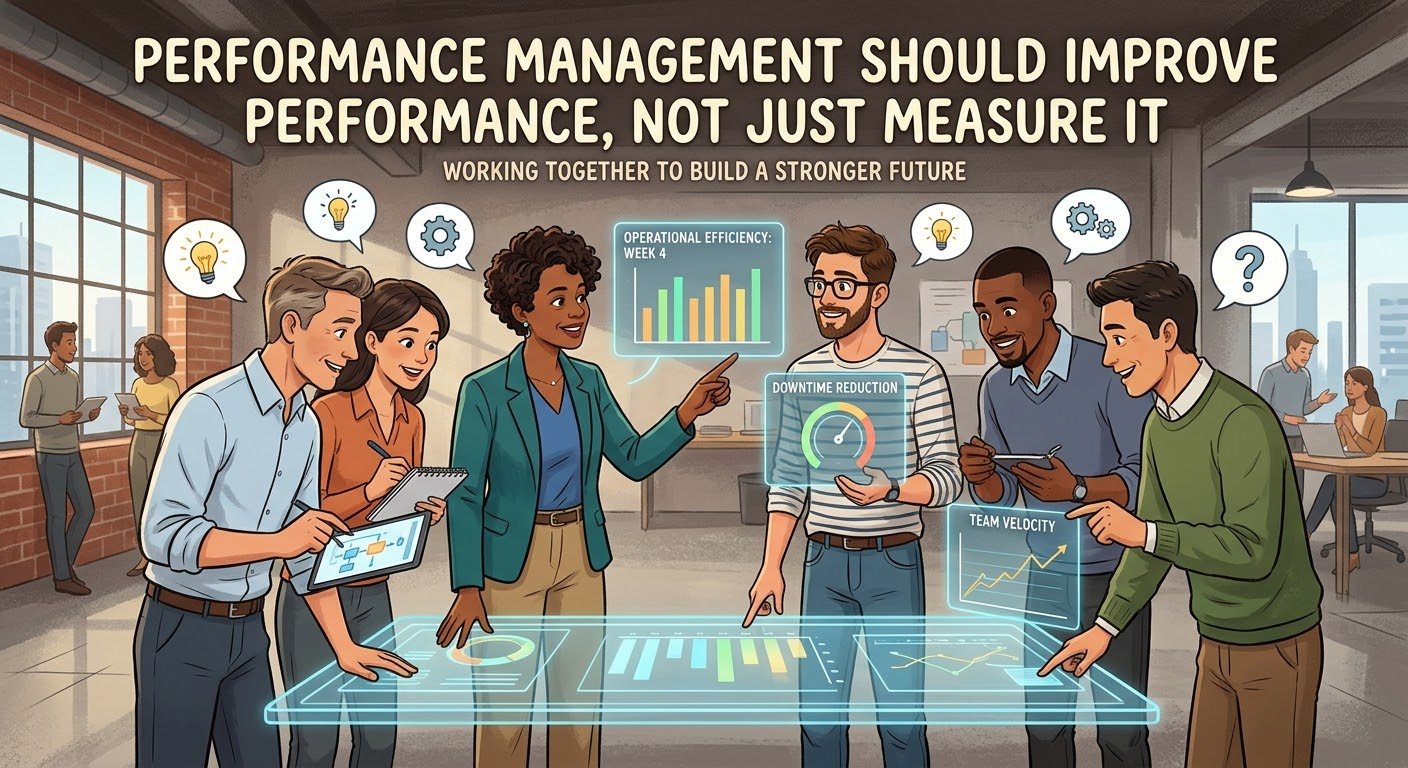
Performance management is one of those expressions that can mean very different things in different organisations.
For some, it is primarily an annual exercise: objectives are agreed, forms are completed, ratings are assigned and conversations take place. For others, it is a more continuous process through which people understand what is expected, receive feedback, address obstacles and improve their contribution.
The difference matters.
An organisation cannot become excellent simply by becoming better at recording performance. Performance management should help the organisation improve performance. That sounds obvious. In practice, however, the systems organisations create around performance can sometimes become more focused on measurement, compliance and documentation than on the performance itself.
The purpose should be the other way around.
MEASUREMENT IS NOT PERFORMANCE
A measure tells us something about performance. It does not, by itself, improve performance.
This distinction is important because organisations can become fascinated by dashboards, scorecards and key performance indicators. The availability of more data can create the impression that performance is being managed more effectively.
However, knowing that a target has been missed does not explain why it was missed, what should happen next or whether the target itself is still appropriate.
A useful performance system should stimulate better questions, such as… What happened? What contributed to the result? What is within our influence? What needs to change? What support is required? What can we learn?
The conversation around the measure is often more valuable than the measure itself.
FROM TARGETS TO OUTCOMES
Targets are useful because they give people something specific to work towards. The danger comes when a target becomes the purpose rather than a means of achieving the purpose.
Consider a service team that is expected to respond to customer enquiries within a particular timeframe. Meeting the response-time target may look positive. However, if the responses do not resolve the customer’s issue, the organisation may have achieved the measure without achieving the outcome it actually needs.
This is why performance management needs to distinguish between activity, output and outcome.
A team can process a large number of cases, complete many tasks or meet a numerical target without necessarily creating the result that matters. The performance conversation therefore needs to move beyond “Did we hit the number?” towards “Did we achieve what the number was intended to represent?” That shift can change how people manage their work.
PEOPLE NEED CLARITY
People cannot perform effectively if expectations are unclear.
Clarity means more than giving someone a job description or a list of annual objectives. People need to understand what matters most, how their contribution connects to organisational priorities and what good performance looks like.
This connects directly with the question of organisational alignment that I explored in my previous Excellence at Work reflection. If the organisation’s strategic priorities do not translate into meaningful expectations at team and individual level, performance management can become disconnected from strategy.
People may work hard and still pull in different directions. This is why objectives should not exist in isolation. They should make sense in the context of the outcomes the organisation is trying to achieve.
FEEDBACK SHOULD NOT WAIT FOR THE APPRAISAL
One of the weaknesses of traditional performance management is that feedback can become associated with a scheduled review.
Feedback is most useful when it is close enough to the work for the person to understand what happened and respond to it.
This does not mean that managers should constantly criticise or monitor their employees. Effective feedback includes recognition, clarification, coaching, challenge and support. The objective is to help people understand what is working, what is not working and what they can do differently.
When feedback becomes part of normal management conversations, the annual review can become a summary of an ongoing dialogue rather than the only significant conversation about performance.
PERFORMANCE PROBLEMS ARE NOT ALWAYS PEOPLE PROBLEMS
This is one of the most important distinctions in performance management. When performance is below expectation, the first reaction can be to ask what is wrong with the person.
Sometimes the issue is capability. However, there are many other possibilities…
The process may be poorly designed. The person may lack the information needed to make a decision. Equipment may not be reliable. The workload may be unreasonable. Different departments may be creating conflicting requirements. The objective may be unrealistic. Also, the person may not have the authority required to influence the outcome for which they are being held responsible.
If leaders treat every performance gap as an individual failure, they may end up coaching people to work harder inside a system that is making good performance unnecessarily difficult.
This is where performance management connects with operational excellence. A performance problem should sometimes trigger a question about the system in which the performance occurs.
WHAT HAPPENS AT THE GEMBA?
One useful way to understand performance is to go closer to where the work happens.
At the Gemba (the place where the work happens), leaders can observe processes rather than relying exclusively on reports about those processes. They can ask people what makes the work difficult, where delays occur, what customers experience and what prevents the desired result from being achieved consistently.
This does not mean bypassing managers or turning every leader into an operational supervisor. It means recognising that performance data tells only part of the story.
The people doing the work often have important information about the conditions that influence performance. Listening to that information can help leaders distinguish between a capability problem and a process problem, between a motivation issue and an obstacle created by the system.
PERFORMANCE MANAGEMENT SHOULD SUPPORT IMPROVEMENT
A good performance system should not merely identify gaps. It should help people and organisations respond to those gaps.
If a target is missed, the next question should not automatically be, ‘Who is responsible?’ A better starting point may be, ‘What happened, why did it happen, and what should we do about it?’
That does not remove accountability. In fact, it can strengthen accountability because it shifts attention from blame to ownership and action.
The person responsible for the result still has a role to play. So does the manager and the process owner. Leadership also has its own role to play if the organisation has created conditions that make the expected result difficult to achieve.
Performance improvement is therefore a shared organisational responsibility, even though individual accountability remains important.
WHAT ARE WE REWARDING?
Performance management also needs to be considered alongside recognition and reward.
People notice what an organisation rewards, tolerates and ignores. The relationship between measures and rewards is important because people naturally pay attention to what the organisation appears to value. If a particular number is rewarded without sufficient regard to how it is achieved, employees may reasonably conclude that the number matters more than the wider outcome.
Similarly, if collaboration is presented as an organisational value but the performance system consistently rewards individual results without recognising contribution to the wider team, employees receive mixed messages.
The performance system therefore communicates organisational values, whether leaders intend it to or not.
FROM ANNUAL EVENT TO DAILY MANAGEMENT
I believe the strongest performance management systems are connected to daily management. That does not mean turning every working day into a formal appraisal.
It means creating enough clarity and rhythm for people to know what matters, understand how performance is progressing, identify problems early and take corrective action.
Objectives provide direction. Measures provide information. Reviews create opportunities for reflection. Feedback supports learning. Action addresses gaps.
Together, these elements can create a cycle of performance improvement. This is also where the discipline of PDCA can be useful. Plan what needs to be achieved, do the work, check the results and act on what has been learned.
Performance management should therefore not be separate from continuous improvement. It can be one of the mechanisms through which continuous improvement becomes part of how the organisation operates.
THE QUESTION IS NOT ‘HOW DID YOU SCORE?’
A performance conversation should eventually answer a more useful question than whether someone received a particular rating.
It should help answer: What are we trying to achieve? How are we doing? What is helping? What is getting in the way? What have we learned? What needs to happen next?
These questions create a conversation about performance rather than merely a judgement about performance.
There will still be a place for ratings, formal reviews and documented objectives where they are useful. The point is not to eliminate structure, but to make the structure serve performance.
SOME QUESTIONS FOR REFLECTION
If your organisation stopped its formal appraisal process tomorrow, would managers and employees still have meaningful conversations about performance? Would people still know what matters, identify problems early, give and receive feedback, and improve how work is done?
If the answer is no, perhaps performance management has become too dependent on the process.
Performance management should not exist simply because organisations need an appraisal process. It should exist because organisations need people, teams and systems to perform better.
The measure is not whether the appraisal was completed, but whether performance improved. That is a very different standard!
ABOUT KOLA OLUTIMEHIN
Kola Olutimehin (getKOLA) is a Business Excellence Consultant who helps organisations achieve operational excellence through effective leadership, employee engagement, continuous improvement and organisational transformation.
If you find these reflections useful, follow Kola Olutimehin (getKOLA) for more thoughts on leadership, business excellence, organisational transformation, achievement and purposeful growth. You may also subscribe to our newsletters here, and connect with Kola via getKOLA.


Kola Olutimehin is a Business Excellence Consultant, who assists organisations in the achievement of operational excellence. He is a Director with the International Lean Six Sigma Institute (ILSSI), the David Hutchins International Quality College (DHIQC), and the Global Excellence Team (GET).
The International Lean Six Sigma Institute (ILSSI) is one of the leading international Lean Six Sigma professional and certification organisations, recognised globally. Kola’s involvement with ILSSI, DHIQC and GET reflects his continuing work in business excellence, operational excellence, quality and continuous improvement.
_____________________________________________________________________
For enquiries: send us a message HERE or via email at training@makewayglobal.com
Follow us on – LinkedIn | Instagram | X | Facebook
📩 Email: training@makewayglobal.com 🌐 Website: www.makewayglobal.com