Learn how to excel at leadership and management
Sign up for our newsletter and get access to a broad range of training information and materials which will help to improve your business processes and career prospects.

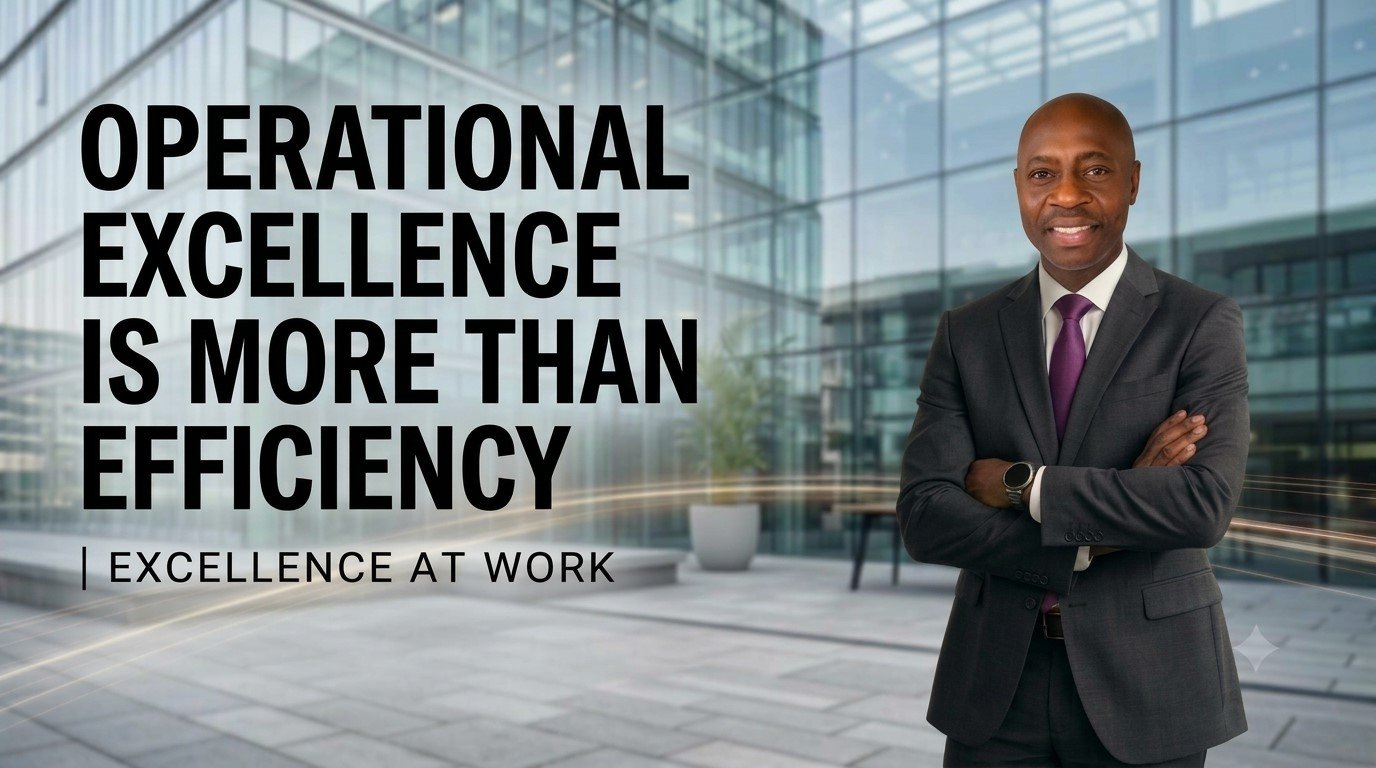
There is a phrase I hear increasingly in organisations: operational excellence. Operational excellence is not simply about doing things faster. It is not synonymous with cost reduction. It is not a project that begins when performance is poor and ends when the numbers improve. For me, operational excellence is about creating an organisation that is capable of consistently delivering the outcomes it exists to deliver, and works towards becoming better at doing so. That requires much more than efficient processes. It requires leadership, clear priorities, capable and engaged people, disciplined processes, measurement, problem solving and a culture in which improvement becomes part of how work is done.
The difference between efficiency and excellence
Don’t get me wrong, efficiency definitely matters. But an organisation can be efficient and still be ineffective. You can process more transactions per hour and still be serving the wrong customer need. You can reduce costs and damage quality. You can shorten a process and create problems for the next department. You can improve one part of an organisation while making the whole system worse. This is why I see operational excellence as broader than efficiency. The question is not simply, ‘How can we do this faster or cheaper?’ It is also:
Operational excellence therefore connects efficiency with effectiveness, quality, reliability, customer value and continuous improvement.
The organisation must know what it is trying to achieve
Operational excellence cannot exist independently of organisational purpose and strategy. People need to understand what the organisation is trying to achieve and how their work contributes to it. This sounds obvious, yet many organisations struggle to make that connection real. Strategy may be clear in the boardroom but less clear at the point where work actually happens. Operational excellence requires the organisation to connect the dots.
The people doing the work often know the work best
This connects directly with a point I made in my earlier article, What 30+ Years of Business Excellence Taught Me About People: the brains within the organisation are not restricted to the boardroom. People who work within a process every day see things that may be invisible to senior management. They experience the delays, duplication, workarounds, customer frustrations and unnecessary effort. Yet organisations sometimes ask those people to follow processes without asking them to improve the processes. That is a missed opportunity. If people are expected to own results, they need the opportunity to contribute to how those results are achieved. This does not mean everyone makes decisions about everything. It means that organisations create appropriate mechanisms for people to identify problems, offer ideas, test improvements and take responsibility for making work better. This is where employee engagement and operational excellence meet. People are more likely to care about improving a process when they believe their observations matter and their contribution can make a difference.
Process excellence is not about making people fit bad processes
I have seen organisations respond to operational problems by adding more controls, more approvals, more forms and more reporting! How misplaced and frustrating! Sometimes that is just the organisation simply making a poor process even more complicated. We need to ask:
This is the thinking behind many of the approaches associated with Lean and Six Sigma. The tools matter, but the thinking behind them matters even more. The objective is not to deploy tools because they are fashionable. The objective is to understand the work, identify what prevents good performance and systematically improve it.
Measurement must drive learning, not just reporting
Another common misunderstanding is to equate operational excellence with having lots of performance indicators. A dashboard can tell you that performance is declining. It does not necessarily tell you why. Good performance management should help an organisation understand what is happening, why it is happening and what needs to be done. A useful measure should help people answer questions such as:
Measurement should therefore become part of the learning system of the organisation. When the numbers reveal a problem, the response should not automatically be blame. It should be inquiry, with such questions as:
Leadership sets the conditions for excellence
Operational excellence is often presented as an operations problem, but I see this differently. For me, it is a leadership responsibility. Leaders determine what receives attention. They determine what gets measured, what gets rewarded and what gets tolerated. If leaders demand improvement but punish people who identify problems, improvement will not flourish. If leaders say they want innovation but insist that everything must be done exactly as it has always been done, people quickly learn the real message based on what is portrayed and not what was said. Leadership therefore has to create the conditions in which operational excellence can survive. This includes clarity of direction, accountability, appropriate empowerment, honest conversations, disciplined follow-through and a willingness to confront problems rather than hide them.
Continuous improvement must become normal day-to-day work
One of the greatest dangers is treating operational excellence as an initiative. An organisation launches an improvement programme. People attend workshops. Teams complete projects. There is enthusiasm. Results improve. Then attention moves elsewhere! For operational excellence to endure, improvement has to become part of normal management. Problems should be visible, and people should be encouraged to solve them. Processes should be reviewed, performance should be discussed, and lessons should be captured. Successful improvements should be standardised where appropriate, and the organisation should continue asking: ‘What can we do better?’ This is where continuous improvement becomes more than a methodology. It becomes a way of thinking.
Excellence is a journey, not a destination
I deliberately use the word ‘journey.’ I do not believe an organisation reaches a point at which it can declare, ‘We have achieved operational excellence, and we can now stop improving.’ Markets change. Customers change. Technology changes. People change. Regulations change. Competitors change. Operational excellence therefore requires adaptability as well as discipline. The measures that mattered yesterday may not be sufficient tomorrow. Excellence requires the humility to recognise this.
Bringing it all together
When I think about operational excellence, I do not think first about a collection of tools. I think about an organisation in which several things work together, like:
That is why operational excellence is more than efficiency. Efficiency asks whether we are using resources well. Operational excellence asks a bigger question: are we consistently creating the outcomes that matter, and are we continually improving our ability to do so? This distinction matters, because an organisation can become very efficient at doing the wrong things. The real opportunity is to build an organisation where people, processes and performance are aligned towards meaningful results, and where improvement is not something that happens occasionally, but something the organisation has learned to do continuously as part and parcel of work. That, to me, is the essence of operational excellence.
A couple of questions for you
Where in your organisation is there the greatest opportunity to improve the way work is done? Also, are the people closest to that work being given the opportunity to help improve it? I would be interested in hearing your experience.
ABOUT KOLA OLUTIMEHIN
Kola Olutimehin (getKOLA) is a Business Excellence Consultant who helps organisations achieve operational excellence through effective leadership, employee engagement, continuous improvement and organisational transformation.
If you find these reflections useful, follow Kola Olutimehin (getKOLA) for more thoughts on leadership, business excellence, organisational transformation, achievement and purposeful growth. You may also subscribe to our newsletters here, and connect with Kola via getKOLA.


Kola Olutimehin is a Business Excellence Consultant, who assists organisations in the achievement of operational excellence. He is a Director with the International Lean Six Sigma Institute (ILSSI), the David Hutchins International Quality College (DHIQC), and the Global Excellence Team (GET).
The International Lean Six Sigma Institute (ILSSI) is one of the leading international Lean Six Sigma professional and certification organisations, recognised globally. Kola’s involvement with ILSSI, DHIQC and GET reflects his continuing work in business excellence, operational excellence, quality and continuous improvement.
_____________________________________________________________________
For enquiries: send us a message HERE or via email at training@makewayglobal.com
Follow us on – LinkedIn | Instagram | X | Facebook
📩 Email: training@makewayglobal.com 🌐 Website: www.makewayglobal.com