Learn how to excel at leadership and management
Sign up for our newsletter and get access to a broad range of training information and materials which will help to improve your business processes and career prospects.

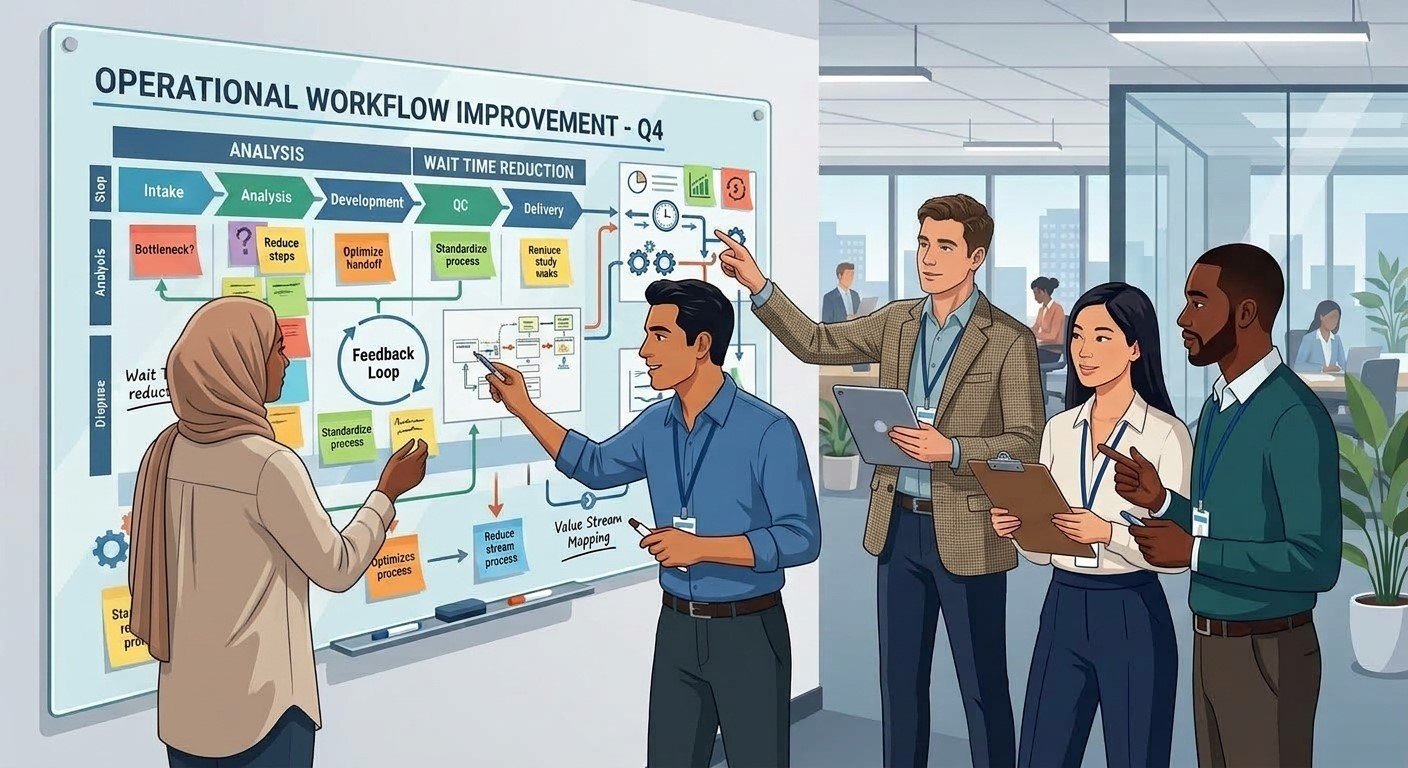
There are not many expressions in business that sound more universally acceptable than continuous improvement. Most organisations would agree that they should continually improve. However, I have found that there is a real difference between believing in continuous improvement and creating an organisation in which improvement happens continuously.
I have worked with organisations where improvement was treated as a major initiative. There would be a project, a team, targets and presentations. Then, after a while, attention moved elsewhere and the organisation returned to doing business as usual.
That does not necessarily mean the organisation stopped believing in improvement. It may simply mean that improvement was treated as something to do rather than a way of working that becomes natural to the employees.
Continuous improvement becomes powerful when it stops being something an organisation does and becomes part of how the organisation works.
There is nothing wrong with improvement projects. Sometimes an organisation needs a focused intervention to address a significant performance problem, redesign a process, reduce waste or respond to major change.
However, if improvement only happens when management launches a project, what happens during the course of day-to-day work and in between the projects?
How do we then deal with the impact of work that continues every day?
Every one of these, and more, create an opportunity to learn.
Continuous improvement begins when an organisation becomes interested in those opportunities as part of normal work. It asks: What happened? Why did it happen? What can we learn? What could we do differently? And did the change actually make things better?
These are not questions that should only appear in management meetings. They should increasingly become part of how people think about their work.
This connects directly with something I wrote about in an earlier reflection: The brains within the organisation are not restricted to the boardroom.
People who perform a process every day often see things that those further removed from it may not see. They know where customers experience frustration, where information gets lost, which procedures are difficult to execute and which workarounds people have developed simply to get the job done. This is why employee involvement matters to continuous improvement.
If an organisation expects improvement to come only from senior management, consultants or specialist teams, it may be leaving considerable knowledge unused. It certainly is not enough to tell employees to ‘speak up.’ The organisation must create an environment in which speaking up is worthwhile. People need to believe that their observations will be taken seriously and that raising a problem will not automatically make them the problem.
They also need to see what happens to their ideas. You cannot ask people to improve the work while making them feel that the work is not theirs to influence.
An organisation can become very good at fixing problems without becoming very good at improving. For example: A machine breaks down and it is repaired | A customer complains about a matter and the complaint is resolved | An error is discovered and corrected | A delay occurs and someone intervenes
These responses may be necessary. However, if the same problems continue to return, the organisation may simply be becoming more efficient at firefighting.
Continuous improvement asks a deeper question: What can we change so that the problem is less likely to occur again?
That requires looking beyond the immediate symptom. Was the process poorly designed? Was the information unclear? Was responsibility uncertain? Was the standard unrealistic? Was there a failure in communication?
The objective is not to create an organisation in which nothing ever goes wrong. That is unrealistic. The objective is to create an organisation that learns from what happens and becomes better because of that learning.
There is sometimes a temptation to associate improvement with dramatic transformation: the major technology investment, the complete process redesign or the transformation programme.
Sometimes those things are necessary, but continuous improvement can also be much smaller, such as: A form can be simplified | An unnecessary approval can be removed | Information can be made available earlier | A recurring source of error can be eliminated | A process can be rearranged so that people do not repeatedly retrace their steps
None of these may make a dramatic presentation to the board. However, where such is repeated across hundreds or thousands of transactions, small improvements can become significant.
The important point is that the organisation develops the habit of looking for them.
Continuous improvement also requires measurement. But measurement can be misunderstood.
If people believe that measurement exists mainly to catch them doing something wrong, they may become more concerned with protecting the numbers than improving the work.
Good measurement should help an organisation understand performance. Are we achieving what we intended? Where is performance changing? What is causing the change? What have we learned? What should we try next?
This is where Plan–Do–Check–Act (PDCA) remains particularly useful.
Then begin again.
Its power comes from making learning part of action. Improvement is not simply about having ideas. It is about testing those ideas, observing the results and learning from the evidence.
It is easy to say that employees should continuously improve. Leadership has a responsibility too.
The answers tell people what the organisation really believes about improvement.
If every mistake is punished, people will become cautious. If every challenge to the status quo is interpreted as resistance, people will stop questioning. If improvement ideas disappear into a management system and nobody hears what happened to them, people will eventually stop submitting them.
Culture is not created by what leaders say about improvement. It is reinforced by what happens when people try to improve something.
This is why I do not see continuous improvement as merely another item on the strategic plan or simply another component of operational excellence. A strategy can establish direction, a programme can create focus, and a project can deliver a specific change.
However, a culture of continuous improvement creates an ongoing organisational capability. It says: We do not assume that because something has always been done this way, it must continue to be done this way.
It also says: We are prepared to learn, and that improvement is everyone’s business.
This does not mean changing things for the sake of changing them. Continuous improvement is not continuous disruption. Sometimes the right conclusion after examining a process is that it works well and should remain as it is.
The discipline is in being willing to ask the question.
Continuous improvement should also have a purpose. An organisation should not improve a process simply because it can. Improvement should contribute to something that matters, such as, better quality, better customer experience, greater reliability, improved productivity, reduced waste, stronger employee experience, better use of resources or the achievement of strategic objectives.
This is where continuous improvement connects with business excellence. The objective is not to keep people permanently occupied with improvement activities. The objective is to create an organisation that gets better at delivering what it exists to deliver.
Perhaps the biggest shift is a simple one.
That is a much more revealing question.
How do people identify opportunities? How are problems investigated? How are ideas tested? How are employees involved? How is learning shared? How are successful improvements sustained?
When these questions become part of everyday organisational life, continuous improvement moves beyond being a management initiative. It becomes a capability.
And when that capability is combined with empowered people, disciplined processes, meaningful measurement and purposeful leadership, improvement becomes part of the way the organisation works. Not another programme, and definitely not another slogan.
It becomes a way of working!
If you stopped all your current improvement projects tomorrow, would your organisation still know how to improve?
—
Kola Olutimehin (getKOLA) is a Business Excellence Consultant who helps organisations achieve operational excellence through effective leadership, employee engagement, continuous improvement and organisational transformation.
If you find these reflections useful, follow Kola Olutimehin (getKOLA) for more thoughts on leadership, business excellence, organisational transformation, achievement and purposeful growth. You may also subscribe to our newsletters here, and connect with Kola via getKOLA.


Kola Olutimehin is a Business Excellence Consultant, who assists organisations in the achievement of operational excellence. He is a Director with the International Lean Six Sigma Institute (ILSSI), the David Hutchins International Quality College (DHIQC), and the Global Excellence Team (GET).
The International Lean Six Sigma Institute (ILSSI) is one of the leading international Lean Six Sigma professional and certification organisations, recognised globally. Kola’s involvement with ILSSI, DHIQC and GET reflects his continuing work in business excellence, operational excellence, quality and continuous improvement.
_____________________________________________________________________
For enquiries: send us a message HERE or via email at training@makewayglobal.com
Follow us on – LinkedIn | Instagram | X | Facebook
📩 Email: training@makewayglobal.com 🌐 Website: www.makewayglobal.com