
Learn how to excel at leadership and management
Sign up for our newsletter and get access to a broad range of training information and materials which will help to improve your business processes and career prospects.

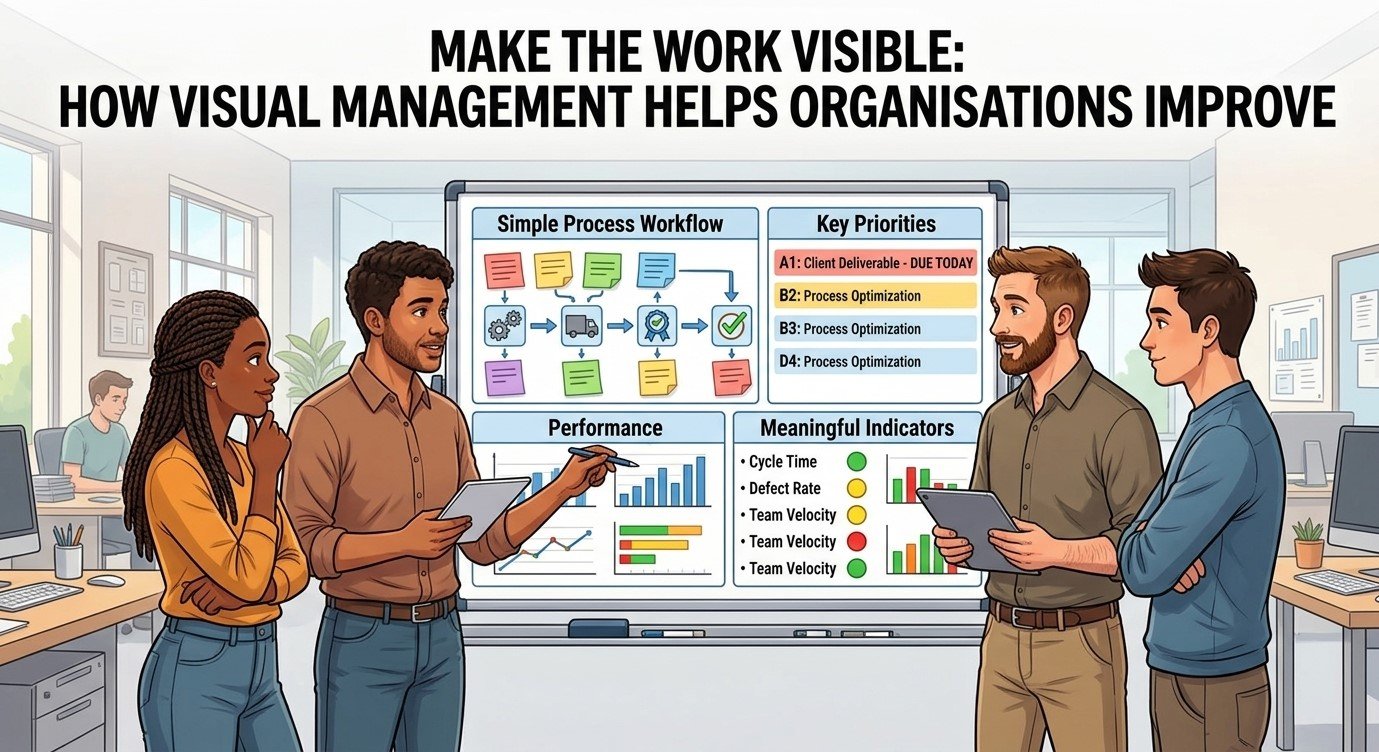
MAKE THE WORK VISIBLE: HOW VISUAL MANAGEMENT HELPS ORGANISATIONS IMPROVE
Organisations generate a great deal of information about their work. Targets are set, reports are prepared, meetings are held and performance data is circulated. Yet it is still possible for people to be unclear about what matters today, where work is delayed, which problems need attention or whether an agreed action has been completed.
This is one reason visual management can be valuable. It makes important information about work easier to see and understand, so that people can respond while there is still an opportunity to influence the result. It is not simply a matter of putting charts on walls or displaying figures on screens. Its purpose is to help people understand the current situation, recognise when something is not going as intended and decide what needs attention.
When used well, visual management connects plans with the reality of daily work. It gives teams a shared picture of what is happening and supports conversations that lead to action.
INFORMATION SHOULD HELP PEOPLE MANAGE THE WORK
A report may tell managers that a target was missed last month. That information can be useful, but it may arrive too late to help a team understand what is affecting today’s work. A visual view of the process can reveal that requests are accumulating at one stage, a key resource is unavailable or an approval is holding up progress.
What matters is whether the information helps those responsible for the work understand the situation and respond. Bring relevant facts closer to the activity they describe, rather than relying only on memory or distant reports.
Not every measure needs to be displayed, and not every team needs a large performance board. Select information because it helps people manage their responsibilities. A display that prompts neither understanding nor action is decoration, not management.
MAKE THE CURRENT SITUATION EASY TO UNDERSTAND
People need a shared understanding of what is expected and what is actually happening. This may involve showing the sequence of a process, the status of work, responsibilities, upcoming deadlines or the measures that indicate whether the process is performing as intended.
Consider a team handling customer requests. If each person keeps a private list, it may be difficult for colleagues to see which requests are waiting, which need information and which are approaching their due dates. A shared visual view can help the team coordinate its work, identify emerging delays and decide where help is needed.
The purpose is not to monitor people for its own sake, but to make work visible so the team can manage it collectively. Clear information helps colleagues support one another and managers address obstacles before they grow. It can also clarify priorities, helping people distinguish what needs immediate attention from what can be planned.
MAKE DEVIATIONS VISIBLE WITHOUT MAKING PEOPLE THE PROBLEM
Visual management helps people recognise when actual conditions differ from the expected method or result. A delayed task, an unusual level of rework, missing information or an interrupted process may signal that something needs attention.
However, visibility is not the same as understanding. An indicator may show where a delay occurs, but people still need to investigate the process and understand why.
The response matters. If displays are used to embarrass individuals or assign blame, people may hide problems or avoid raising concerns. Difficulties should become visible early enough for a constructive response.
This connects with Stop Solving the Same Problems: Why Organisations Need to Learn from Them. Problems that remain hidden are difficult to understand, and problems that are repeatedly displayed without being investigated are unlikely to disappear. Visibility should lead to learning and action, not simply more reporting.
TAKE THE INFORMATION TO WHERE THE WORK HAPPENS
Information is most useful when it reflects the reality of the activity. A dashboard prepared at a distance may show that performance is below target, but it may not reveal the practical conditions behind the result. The people doing the work may be dealing with unclear instructions, unavailable materials, duplicated checks or an approval process that creates unnecessary waiting.
Leaders and managers need to go closer to the work, observe what is happening and listen to the people involved. This is the practical significance of Gemba: understanding the place where value-creating work takes place rather than relying only on summaries about it.
Visual management can support these conversations by bringing relevant process information into view. The display does not replace observation or discussion; it helps focus them. The question is not simply whether a figure is green or red, but what has changed and what may be preventing the expected result. Its first purpose is to help people responsible for the work understand and improve it, while also supporting wider coordination.
CONNECT DAILY WORK WITH THE ORGANISATION’S PRIORITIES
People can be busy without being clear about how their efforts contribute to organisational priorities. A team may meet its local targets while delays or inefficiencies elsewhere undermine the overall outcome. Visual management can help make these connections more visible.
For example, a department may track the speed at which it completes its own tasks, while the organisation is concerned with the time taken to deliver a complete service to the customer. If the local measure is considered in isolation, the department may optimise its own activity without noticing that it is creating additional work for another team.
The information displayed should therefore help people understand both their immediate responsibilities and the outcomes that matter beyond their own area. This is consistent with the thinking in Strategy Must Reach the Work: Why Organisational Alignment Matters. Organisational priorities become meaningful when people can see how daily activities contribute to them and when information from the work can inform decisions at higher levels.
The aim is to connect organisational direction with team priorities and daily responsibilities.
KEEP THE DISPLAY SIMPLE, CURRENT AND USEFUL
Visual management can fail when displays become complicated or outdated. A board may begin with a few useful indicators but gradually accumulate more charts, colours and information until people no longer know where to look. Another may show yesterday’s position even though the work has changed significantly since then.
Design the display around the decisions it needs to support. What must the team know, how often should the information be updated, who maintains it and what happens when attention is needed? The answer may be a simple workflow display rather than a sophisticated dashboard, or a clear visual instruction rather than another report. The best format is one people can understand and use reliably.
Remove information that no longer serves a purpose. Visual management should reduce confusion, not create another administrative burden. If nobody uses a display to understand work or make decisions, question whether it is needed.
MAKE VISIBILITY LEAD TO ACTION AND LEARNING
A team may become very good at updating a board without improving the process it describes. This happens when the display becomes the outcome rather than a means of managing work.
When a problem becomes visible, the team must decide what response is needed. Some issues can be resolved immediately; others require another department, management support or further investigation. Responsibilities and follow-up should be clear so that the issue does not simply reappear at the next review.
The team should also look at whether the action made a difference. Did the delay reduce? Has rework fallen? Is information now reaching the next stage correctly? If the change has not produced the expected result, the team may need to reconsider its explanation or try another approach.
This is where visual management connects with Performance Management Should Improve Performance, Not Just Measure It. Measures and displays are useful when they help people understand performance, identify barriers and improve results. They have limited value when the process stops at recording and presenting numbers.
LEADERSHIP SETS THE CONDITIONS FOR HONEST VISIBILITY
Leaders influence whether people trust the information being displayed and feel able to discuss what it reveals. If an unfavourable result is met with anger, employees may be tempted to conceal it or explain it away. If a problem is raised and then ignored, people may conclude that making it visible achieves little.
Leaders should respond with curiosity and consistency, listen to people closest to the work and remove obstacles teams cannot resolve themselves. They should distinguish a process problem from a failure to meet an agreed responsibility.
Visual management cannot replace leadership, judgement or trust. It makes information available; people determine how to use it. Their conversations decide whether visibility becomes a source of learning or another form of scrutiny.
A QUESTION FOR REFLECTION
Consider one area of work in your organisation where people regularly ask for updates, chase information or discover problems later than they should. What would need to be made visible so that the team could understand the situation earlier and respond more effectively?
The answer may not require new technology or a complicated dashboard. It may begin with a clear view of the work, a few meaningful indicators and a regular conversation about what needs attention.
Visual management is not about making an organisation look organised. It helps people see the work clearly enough to manage it, recognise when it needs attention and improve it. When information is visible, current and connected to action, it becomes a practical link between what the organisation intends to achieve and what people do every day.
—
ABOUT KOLA OLUTIMEHIN
Kola Olutimehin (getKOLA) is a Business Excellence Consultant who helps organisations achieve operational excellence through effective leadership, employee engagement, continuous improvement and organisational transformation.
If you find these reflections useful, follow Kola Olutimehin (getKOLA) for more thoughts on leadership, business excellence, organisational transformation, achievement and purposeful growth. You may also subscribe to our newsletters here, and connect with Kola via getKOLA.


Kola Olutimehin is a Business Excellence Consultant, who assists organisations in the achievement of operational excellence. He is a Director with the International Lean Six Sigma Institute (ILSSI), the David Hutchins International Quality College (DHIQC), and the Global Excellence Team (GET).
The International Lean Six Sigma Institute (ILSSI) is one of the leading international Lean Six Sigma professional and certification organisations, recognised globally. Kola’s involvement with ILSSI, DHIQC and GET reflects his continuing work in business excellence, operational excellence, quality and continuous improvement.
—
Written by Kola Olutimehin
© 2026 Kola Olutimehin. All rights reserved.
No part of this article may be reproduced or redistributed without prior written permission from Kola Olutimehin, except where permitted by law.
_____________________________________________________________________
For enquiries: send us a message HERE or via email at training@makewayglobal.com
Follow us on – LinkedIn | Instagram | X | Facebook
📩 Email: training@makewayglobal.com 🌐 Website: www.makewayglobal.com