Learn how to excel at leadership and management
Sign up for our newsletter and get access to a broad range of training information and materials which will help to improve your business processes and career prospects.

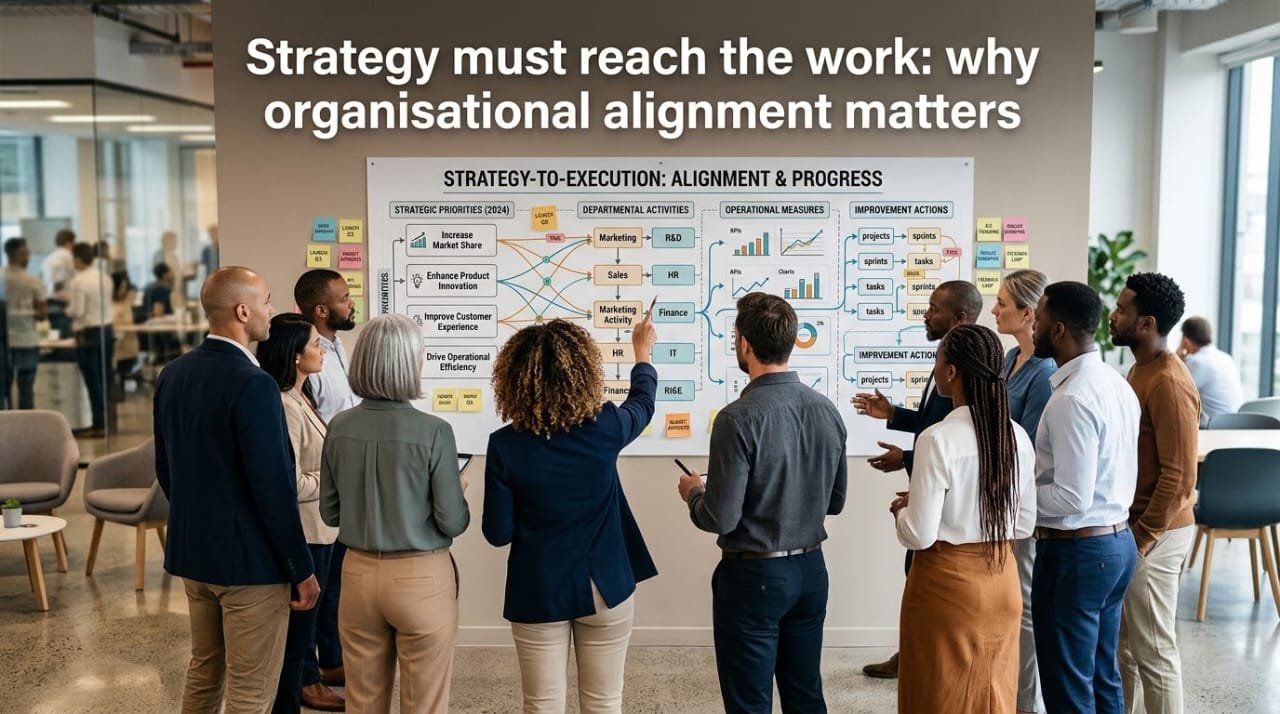
A strategy can be carefully considered, professionally presented and approved, but still fail to influence what happens in the organisation every day.
The problem is not necessarily the strategy itself. Sometimes the missing link is what happens between strategic intention and daily work.
An organisation may have a clear vision, ambitious objectives and a detailed strategic plan. Yet people across departments may still be making decisions based on different priorities. Managers may be pursuing targets that compete with one another. Employees may understand what their own function is expected to deliver without seeing how that work contributes to the organisation’s wider direction.
This is where organisational alignment matters to operational excellence. For me, alignment is not simply about getting everyone to agree with the strategy. It is about creating a practical connection between where the organisation wants to go and what people actually do.
STRATEGY CANNOT REMAIN AN EXECUTIVE DOCUMENT
There is nothing wrong with a strategy being developed by senior leadership; leadership has an important responsibility to provide direction. The challenge begins when strategic direction remains largely at that level in terms of its understanding and workability.
A strategic plan can contain impressive objectives, priorities and initiatives. However, customers experience strategy through products, services, processes, decisions, responsiveness and behaviour. And that means strategy eventually has to reach the work.
People need to understand, not only what the organisation wants to achieve, but also what that means for their function, their team and their own work. This does not mean turning every employee into a strategist, giving people enough understanding of the direction to make better decisions about the work they influence.
ALIGNMENT IS MORE THAN CASCADING TARGETS
One common approach is to take a corporate objective and cascade it downwards.
On paper, this can look like alignment. But targets can be connected numerically without being connected operationally.
A sales target, for example, may be increased without considering whether operations can support the resulting volume, whether service teams can manage the customer experience, or whether the organisation has the capability and capacity required.
The issue is whether the organisation understands the relationships between them.
Real alignment asks a broader set of questions:
These questions turn strategy from a statement of intent into something people can work with.
THE WORK IS WHERE STRATEGY BECOMES REAL
An organisation can have an excellent strategy and poor execution because the strategy has not been translated into the reality of work.
This is why I believe leaders need to stay connected to the work. And not necessarily by taking over operational decisions, but by understanding what actually happens where value is created and where customers experience the organisation.
The Gemba principle is useful here: go to where the work happens, observe, ask questions and learn.
The closer leaders get to the place where the actual work is done, the easier it becomes to see the gap between what the organisation says it wants and what its systems actually enable people to do.
Sometimes the problem is capability, process design, measures or conflicting departmental priorities. Or people simply do not understand the connection between their work and the strategic priorities.
These are not necessarily people problems. They can be system problems, and they require system thinking.
ALIGNMENT SHOULD WORK IN BOTH DIRECTIONS
Alignment is sometimes presented as a one-way exercise: leadership decides, and the rest of the organisation implements. I see it differently.
Direction may come from leadership, but understanding what is required to achieve that direction should involve the people who will have to make it happen.
The people closest to the work often know things that are not visible in executive meetings. They see recurring delays, customer frustrations, process constraints and handoff failures. They may also know which proposed improvements are unlikely to work in practice.
This is one reason employee involvement matters. It does not remove leadership responsibility, but strengthens leadership decision-making by bringing operational knowledge into the conversation.
In approaches such as Hoshin Kanri, this connection between strategic direction and the work is deliberately structured. Strategy is translated into objectives and activities, while dialogue across levels helps test whether the direction is realistic and how it can be achieved.
The principle is important even when an organisation does not formally use Hoshin Kanri: Strategy should travel into the organisation; information from the organisation should travel back into strategy.
That two-way movement is part of genuine alignment.
MEASURES CAN CREATE ALIGNMENT OR DISTORT IT
What an organisation measures tells people what matters. However, measures can have unintended consequences.
If one department is rewarded primarily for reducing its own costs, it may make decisions that increase costs elsewhere. If a team is rewarded for processing volume, it may prioritise speed over quality. If managers are judged only on short-term financial results, they may underinvest in capability, maintenance, relationships or improvement.
This is why performance measures should not be designed in isolation. Measures should help people understand the outcomes the organisation needs and the processes that influence those outcomes.
A useful measure should stimulate a useful conversation…
This is where measurement connects with continuous improvement.
PDCA [Plan | Do | Check | Act] provides a simple discipline for learning from action. Rather than assuming that a plan will work simply because it has been approved, the organisation tests, measures, learns and adjusts.
Strategy therefore becomes something that is managed and learned from, not something that is simply announced.
LEADERSHIP SETS THE CONDITIONS
Alignment is not created by documents alone. Leadership behaviour matters.
If leaders constantly change priorities, people will struggle to know what really matters. If they reward behaviours that contradict the stated strategy, the organisation will follow the reward system rather than the strategy. If they ask for openness but punish people who surface problems, information will disappear.
People pay attention to what leaders consistently do. That is why strategy execution is also a leadership discipline. Leaders need to create clarity, maintain focus, remove barriers, listen to evidence and review progress.
They also need to recognise that alignment does not mean uniformity. Different functions have differing responsibilities. The objective is not to make everyone do the same thing; it is to make different parts of the organisation work towards compatible outcomes.
FROM STRATEGY TO DAILY MANAGEMENT
The real test of strategy is not what people remember from the strategy launch. It is what they use when making decisions on an ordinary Tuesday morning, for example.
Does the strategy influence priorities, resource allocation, meetings, performance conversations and improvement activity? Does it influence how problems are escalated and resolved, or what managers ask their teams to focus on?
If the answer is no, the strategy may still be sitting too far away from the work. This is where strategy needs to connect with daily management.
At appropriate levels, the organisation should be able to see what matters, how performance is progressing, where problems are emerging and what action is being taken. That does not require an endless collection of dashboards. It requires useful information, meaningful conversations and disciplined follow-through.
ALIGNMENT IS A LIVING PROCESS
No strategy survives unchanged when it meets reality. Customers, markets, technology, regulation, competitors and internal capability change. Unexpected problems appear and new opportunities emerge.
Therefore, alignment cannot be a one-off exercise completed when the strategic plan is launched. It needs review, learning and adjustment. This is why I see strategy deployment as closely connected to continuous improvement. The organisation sets direction | People act | Results provide information | Leaders and teams learn | Plans are adjusted where necessary | Action continues.
The direction may remain stable while the route changes. That can be evidence that the organisation is learning.
THE QUESTIONS I WOULD ASK
When I look at organisational excellence, I am interested not only in whether an organisation has a strategy. I am interested in whether the strategy can be seen in the work.
These questions matter because organisational excellence is not achieved by having good intentions at the top. It is achieved when direction, people, processes, measures and daily work begin to reinforce one another.
A strategy provides direction, and alignment connects the direction to the organisation. Execution then turns it into action, while learning makes it better, and invariably continuous improvement helps the organisation keep moving.
A QUESTION FOR REFLECTION
If I asked people across your organisation to explain the organisation’s three most important strategic priorities, and then asked them what those priorities mean for their own daily work, would their answers be broadly connected?
If not, perhaps the challenge is not that your people lack commitment. Perhaps the organisation needs to strengthen the connection between strategy and work, because strategy creates value only when people can turn direction into meaningful action.
And organisational excellence begins when the whole organisation can move in the same direction, while still learning from what is happening along the way.
ABOUT KOLA OLUTIMEHIN
Kola Olutimehin (getKOLA) is a Business Excellence Consultant who helps organisations achieve operational excellence through effective leadership, employee engagement, continuous improvement and organisational transformation.
If you find these reflections useful, follow Kola Olutimehin (getKOLA) for more thoughts on leadership, business excellence, organisational transformation, achievement and purposeful growth. You may also subscribe to our newsletters here, and connect with Kola via getKOLA.


Kola Olutimehin is a Business Excellence Consultant, who assists organisations in the achievement of operational excellence. He is a Director with the International Lean Six Sigma Institute (ILSSI), the David Hutchins International Quality College (DHIQC), and the Global Excellence Team (GET).
The International Lean Six Sigma Institute (ILSSI) is one of the leading international Lean Six Sigma professional and certification organisations, recognised globally. Kola’s involvement with ILSSI, DHIQC and GET reflects his continuing work in business excellence, operational excellence, quality and continuous improvement.
_____________________________________________________________________
For enquiries: send us a message HERE or via email at training@makewayglobal.com
Follow us on – LinkedIn | Instagram | X | Facebook
📩 Email: training@makewayglobal.com 🌐 Website: www.makewayglobal.com