
Learn how to excel at leadership and management
Sign up for our newsletter and get access to a broad range of training information and materials which will help to improve your business processes and career prospects.

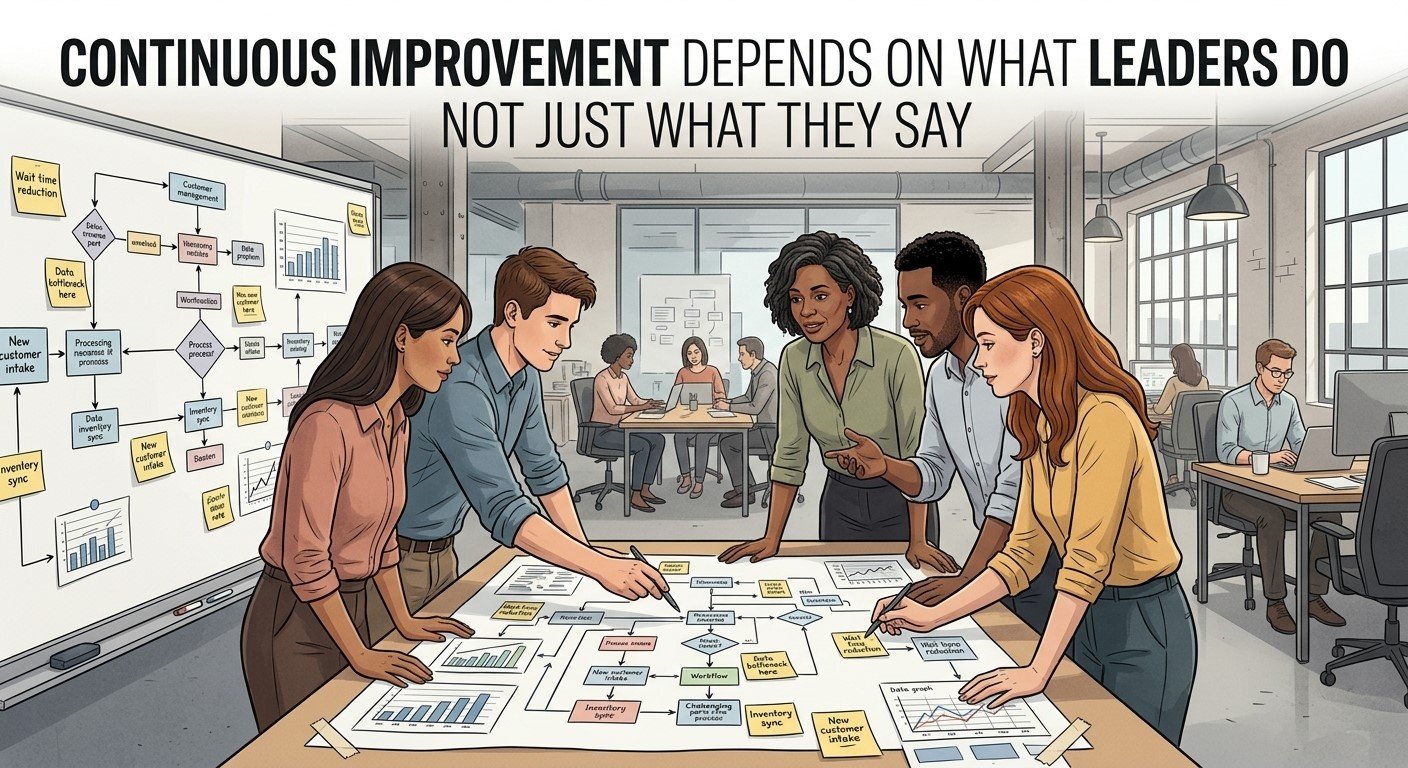
CONTINUOUS IMPROVEMENT DEPENDS ON WHAT LEADERS DO, NOT JUST WHAT THEY SAY
Organisations often declare that continuous improvement is important. It may appear in a strategy, a values statement or a team meeting. Yet those words do not tell us whether improvement has become part of the way the organisation works.
A more revealing test is what happens when an employee questions an established method, reports a problem, proposes a change or admits that an experiment has not worked. Does the response invite learning, or discourage the person from trying again?
People pay particular attention to what leaders do when there is pressure or disagreement. Those moments reveal whether improvement is genuinely valued or only encouraged when convenient.
Continuous improvement cannot be delegated entirely to a project team or quality function. Leaders shape the environment in which people raise concerns, test ideas and learn from results. Their behaviour can make improvement possible, or quietly make it harder.
LEADERSHIP IS REVEALED IN THE RESPONSE
It is easy to say that people should speak up. However, the more important question is what happens when they do.
Imagine an employee points out that a routine process causes avoidable delays. A manager could become defensive or treat the observation as criticism. The employee may conclude that raising the issue was unwise. Alternatively, the manager could ask where the delay occurs, listen to what the employee has observed and explore whether the process can be improved.
This is not simply a matter of being pleasant. It influences the information available to the organisation. When people learn that concerns lead to constructive discussion, they are more likely to share what they know. When their input is dismissed or used against them, silence can become the safer option.
The organisation learns what is genuinely acceptable by watching how managers respond to real situations, not simply by reading its values.
BE CURIOUS BEFORE YOU GIVE AN ANSWER
Managers are often promoted because of their expertise and record of delivering results. It can therefore feel natural to provide an answer quickly when a problem is raised. However, if leaders routinely solve every problem for everyone else, they may prevent people from developing their own problem-solving capability.
Curiosity offers another approach. Instead of immediately telling someone what to do, ask what they have observed, what they believe is causing the difficulty and what options they have considered. The purpose is not to withhold help; it is to understand the situation and help the person develop sound judgement.
Leaders will not always agree with the explanation or proposed solution. They can still explore the evidence before deciding. Asking, ‘What have you noticed, and how might we test that’ can open a more useful conversation than an immediate judgement.
This approach also helps managers distinguish between a capability gap, a process problem, an unclear expectation and a decision that requires intervention. The response can then address the actual need rather than defaulting to instruction.
MAKE IT SAFE TO RAISE DIFFICULTIES
Improvement depends on information. Employees need to be able to say that a process is failing, a target may be unrealistic or a proposed change has created an unintended consequence.
That does not mean every opinion must be accepted or that standards and accountability should be relaxed. People should be able to raise concerns honestly without expecting humiliation or automatic blame. Leaders can challenge a view, ask for evidence and hold people responsible for their decisions while still treating them with respect.
A useful test is what happens when the news is unwelcome. If managers react angrily to bad news, employees may delay sharing it. By the time it reaches the right person, a manageable issue may have become a larger problem. Leaders who focus first on understanding what has happened make it easier for the organisation to see reality clearly.
This connects with Stop Solving the Same Problems: Why Organisations Need to Learn from Them. An organisation cannot learn from problems that people feel unable to report, and it cannot prevent recurrence if the real conditions remain hidden.
INVOLVE PEOPLE, BUT GIVE THEM A REAL ROLE
Asking employees for ideas is not the same as involving them in improvement. People may be invited to a meeting or asked to submit suggestions, yet see little evidence that their contribution influences decisions.
Meaningful involvement requires a clear connection between participation and action. Leaders should explain the problem, clarify constraints, invite people who understand the work to contribute and decide what will be tested. They should also communicate what happened to suggestions, including why an idea was not adopted.
Not every proposal can be implemented. Safety requirements, resources or wider process considerations may make an idea unsuitable. An honest explanation is more useful than allowing a suggestion to disappear without response.
In Why Organisational Excellence Begins With Empowered People, I explored the difference between assigning responsibility and enabling people to influence the work. Leaders need to provide the authority, information, support and boundaries that allow people to contribute effectively.
ALLOW EXPERIMENTS, AND LEARN FROM THE RESULTS
An improvement idea may not produce the expected result. That is not automatically evidence that its proposer was careless or that experimentation should stop. It may reveal a flawed assumption, an overlooked dependency or a condition that needs further investigation.
Leaders must distinguish between a reasonable test carried out responsibly and reckless action that disregards known risks or agreed controls. Improvement is not a licence to ignore standards; it is a disciplined willingness to test ideas, examine evidence and adjust the approach.
When an experiment does not work, ask what it has taught the team. Was the problem understood correctly? Did the change create a consequence elsewhere? What should be retained, adapted or abandoned?
If every unsuccessful attempt is treated as personal failure, people will choose only ideas that appear certain to succeed. That favours safe suggestions and leaves more significant opportunities unexplored. Learning requires thoughtful experimentation and a proportionate response to results.
SHOW THAT IMPROVEMENT MATTERS WHEN PRESSURE RISES
A leadership team may support improvement when business is steady, then abandon it as soon as performance comes under pressure. Meetings are cancelled, investigations stop and employees are told to return to familiar routines because there is no time to improve.
Urgent situations sometimes require a temporary focus on stabilising performance. The concern is when every pressure becomes a reason to suspend improvement. Problems then consume capacity, leaving no time to remove their causes.
Leaders need to make improvement part of how work is managed rather than an activity that depends on spare time. That includes reviewing recurring difficulties, following up agreed actions and checking whether changes have produced the intended effect.
Measures and performance discussions should support this work. As discussed in Performance Management Should Improve Performance, Not Just Measure It, measurement is most useful when it helps people understand performance, address barriers and take action, rather than simply report numbers.
MODEL THE BEHAVIOURS YOU EXPECT
People notice inconsistencies. A leader who asks for ideas but reacts badly to challenge, speaks about learning but conceals personal mistakes, or encourages ownership while retaining every decision sends a mixed message. Behaviour soon carries more weight than stated intention.
Leaders do not need to be infallible. Acknowledging a wrong assumption, asking for help or changing a decision in light of evidence can demonstrate the learning the organisation needs. The important thing is to do so responsibly and explain what has changed.
Consistency also matters across management levels. If senior leaders encourage improvement but middle managers are penalised for making time for it, the message weakens. Leaders need to align expectations, resources, measures and everyday decisions with the behaviours they want to see.
TURN SUPPORT INTO A ROUTINE
Culture is strengthened through repeated behaviour, not occasional speeches. Leaders can make improvement visible through regular conversations about work, time spent understanding processes, follow-up on employee suggestions and reviews of what teams have learned.
These routines need not be elaborate. A team might review a recurring obstacle, agree a small test, identify who will follow up and check the result at its next meeting. The aim is not to create more forms or meetings for their own sake, but to ensure that improvement has a place in the ordinary rhythm of work.
Over time, these routines make leadership support credible. Employees see that their observations are considered, experiments are taken seriously and successful changes are sustained. Improvement becomes less dependent on one enthusiastic manager and more embedded in how the organisation operates.
A QUESTION FOR REFLECTION
Consider how leaders in your organisation respond when someone challenges an established way of working, raises an uncomfortable problem or reports that an improvement has not worked as expected.
Do they show curiosity, ask for evidence and help the team learn? Or do their reactions make people more cautious about speaking up?
The answer may reveal more about your organisation’s improvement culture than any statement of values or strategy.
Continuous improvement is not sustained by asking people to improve while leaving the conditions around them unchanged. Leaders create those conditions through the questions they ask, the responses they give, the time they protect and the behaviours they demonstrate.
The most important question is not only whether leaders support continuous improvement. It is whether their everyday behaviour makes it possible!
—
ABOUT KOLA OLUTIMEHIN
Kola Olutimehin (getKOLA) is a Business Excellence Consultant who helps organisations achieve operational excellence through effective leadership, employee engagement, continuous improvement and organisational transformation.
If you find these reflections useful, follow Kola Olutimehin (getKOLA) for more thoughts on leadership, business excellence, organisational transformation, achievement and purposeful growth. You may also subscribe to our newsletters here, and connect with Kola via getKOLA.


Kola Olutimehin is a Business Excellence Consultant, who assists organisations in the achievement of operational excellence. He is a Director with the International Lean Six Sigma Institute (ILSSI), the David Hutchins International Quality College (DHIQC), and the Global Excellence Team (GET).
The International Lean Six Sigma Institute (ILSSI) is one of the leading international Lean Six Sigma professional and certification organisations, recognised globally. Kola’s involvement with ILSSI, DHIQC and GET reflects his continuing work in business excellence, operational excellence, quality and continuous improvement.
_____________________________________________________________________
For enquiries: send us a message HERE or via email at training@makewayglobal.com
Follow us on – LinkedIn | Instagram | X | Facebook
📩 Email: training@makewayglobal.com 🌐 Website: www.makewayglobal.com